Sunday, 18 December 2011

Best Christmas book ever: The Christmas Miracle of Jonathan Toomey

The best Christmas book ever written is The Christmas Miracle of Jonathan Toomey.

The book was written by Susan Wojciechowski and illustrated by P.J. Lynch. It was first published in 1996.

For a number of years now I have read it to my kids every Christmas. And every time I have had to pause as inevitably something would cause my eyes to water for some unknown reason.

The story is beautifully written and very moving.

This year my daughter Ruth (9) read it aloud instead and again there must have been dust particles in the air because I found myself having to wipe my eyes again.

I cannot recommend it highly enough.

In preparing this posting, I discovered that:
  • Susan Wojciechowski has a website 
  • P. J. Lynch is actually Patrick James Lynch and he is Irish, born in Belfast and, according to his website, currently living in Dublin.
  • The book was made into a movie in 2007. It stars Tom Berenger and Joely Richardson. I see that our own Saoirse Ronan also has a role in the movie. It currently has a rating of 6.6 on IMDB. The movie is available here. Might be worth taking a look.

So many more Irish connections than I was expecting.

Saturday, 17 December 2011

Data, Information and Knowledge

As a result of a project I am doing in work, and some study I am doing for college, I have been thinking about the distinction between data, information and knowledge. I have come up with an example which helps to distinguish them for me and I would like to share it.

Data is the lowest level of these three concepts. Data consists of simple “facts and figures”. For the purpose of this example, the following is a piece of data: 914 baby boys who were born in Ireland in 2010 were given the name Jack. While this fact might (or might not!) be interesting, it is not very informative.

Aside: Intellectually I know that data is the plural of datum. This means that you should use phrases such as “the data tell us”, “the data indicate” and “the data are”. Many phrases such as “entering the data” and “validating the data” are unaffected by this distinction. But I myself find it must more natural to write “once the data has been validated” rather than the correct version of “once the data have been validated”. But maybe that’s just me!

The next level up is Information. Information is gleaned from data by asking questions of it.

Aside: I am reminded of the part of the The Hitchhiker's Guide to the Galaxy books where a supercomputer (“Deep Thought”) is built to answer “the Ultimate Question of Life, the Universe and Everything”. The answer turns out (after 7.5 million years of computation) to be 42 and then the people have to build an even bigger supercomputer to discover the question. So they were looking for knowledge (ultimate knowledge in fact) and they end up with a datum!

In the case of boys’ names, you might want to know where Jack ranked in terms of popularity during 2010 (particularly if you wished to avoid using one of the most popular names). The answer to this question is that Jack ranked number one in terms of popularity. A supplemental question might reveal that the second most popular name (Sean) has 812 occurrences. This is over 100 less which indicates that Jack is the overwhelming favourite. This information would be a red flag for parents who didn’t want to send their son to school with 2, 3 or 4 other Jacks.

So in our example data has fed into information. But does knowing this information equate with having knowledge? I would argue that this is not knowledge because the value of this piece of information decays over time. The information will be less relevant with each passing year. In 5 or 6 years’ time this information (about 2010) may have very little value to people selecting names.
Knowledge is the level above information because it has a much longer shelf-life. Rather than facts and figures, it concerns itself with truth and understanding.

Steven D. Levitt and Stephen J. Dubner wrote an entertaining and thought-provoking book called Freakonomics: A Rogue Economist Explores the Hidden Side of Everything in which they try to extract knowledge from data by asking questions of it (or should I say “them”!).

In relation to baby names, they conclude that the evidence indicates that names move through the population from a higher socioeconomic level to a lower level. They further concluded that when a particular name has been widely adopted then the "high-end parents begin to abandon it," and the whole process starts again with a new crop of names.

You can read the opening of this chapter online on their website here.

Another interesting piece of nascent knowledge in relation to baby names is described on their website. This is that the rate at which a name gains popularity will be mirrored by the rate at which it loses it. You can read it here.

Postscript


Douglas Adams was a genius and the Hitchhiker books are hilarious, full of fun and invention.
But my favourite single quote from Adam is this:
I love deadlines. I like the whooshing sound they make as they fly by.

Wednesday, 14 December 2011

Early Computer Systems

My first job was as a “Computer Operator” in a long-gone company called “Computime” in Dublin.

Computime was a “Computer Bureau”: a company with a computer on whom other companies who could not afford a computer would depend for applications like invoicing, debtors, creditors, payroll, etc.

It’s hard to believe in these days of ubiquitous computing that there was a time when successful businesses did not have a computer of their own!

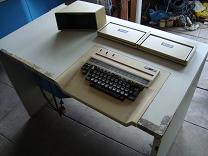
Anyway, when I joined in 1979 they had the following equipment in the computer room:
I'm pretty sure the System/3 had 4K of memory. Not very impressive when my Apple ][ at home had 16K. But the 1403 printing at full speed was a far cry from the Epson dot matrix printer I had at home!

This picture shows an operator (who doesn’t look as any of us did!) changing a removable disk on a System/3:

The “data prep” staff worked in the next room performing key-to-disk operations using a number of IBM 3742 workstations. Here are pictures of the 3741 and 3742:

Simple, happy days.

Some day I must remember to blog about the day one of the operators pulled the “Emergency Pull” switch on the System/3! Heaven only knows why a computer would have such a switch! Perhaps the designers were thinking ahead to the day when one of their creations would become “self-aware”!

Tuesday, 13 December 2011

Best Christmas Songs: Peace on Earth/Little Drummer Boy, Fairytale of New York, White Christmas

So Christmas is well on the way.

As I make this posting, I am listening to the best 3 Christmas songs of all time on Grooveshark.

They are (this is the order I am playing them and also my order of preference):

1) Peace on Earth/Little Drummer Boy - Bing Crosby and David Bowie
2) Fairytale of New York - The Pogues
3) White Christmas - Bing Crosby

Wikipedia has the following to save about songs 1 and 3 above:

Peace on Earth/Little Drummer Boy

Crosby's last TV appearance was a Christmas special filmed in London in September 1977 and aired just weeks after his death. It was on this special that Crosby recorded a duet of "The Little Drummer Boy" and "Peace on Earth" with the flamboyant rock star David Bowie. It was rush-released as a single 45-rpm record, and has since become a staple of holiday radio, and the final popular hit of Crosby's career. At the end of the century, TV Guide listed the Crosby-Bowie duet as one of the 25 most memorable musical moments of 20th-century television.

White Christmas

The song remains the best-selling single of all time. According to Guinness World Records, Crosby's recording of "White Christmas" has "sold over 100 million copies around the world, with at least 50 million sales as singles."

I wish it was OK listen to Christmas music all year round!

I guess if it was then this station wouldn't just be broadcasting during December:
http://christmasfm.ie/

How time flies...

I can't believe it has been over a month since I posted to my blog!

My only excuse is that I had 3 assignments to do for college over the last few weeks and they took up all of my free time, my energy, and my creative juices!

But they're submitted now and I'm back and bursting with ideas!

Wednesday, 9 November 2011

What makes a good programmer? (software developer)

The CEO of one of my former employers was interviewed on the radio recently and made a statement about programmers with which I fundamentally disagree. He stated that mathematics is “absolutely essential” for a programmer. Later in the interview they returned to the subject and he agreed with the suggestion that it should have “double points” for the leaving cert.

I have been working in software development for over 30 years and I have never found a significant use for the mathematics I learned in secondary school or in university.

He may have meant that that the people who are good at maths would also be good at programming (although this is not what he was saying). Even in this I would disagree. I was discussing this with one of the best developers I know and he said “he should take a look at my leaving cert maths results”.

I remember the MD of my first employer (there were no CEOs in those days) telling me that he believed that the best developers were the ones who had worked with punched cards. He believed that being able to see and touch the data gave the developer a more visceral understanding of it. He believed that seeing a card sorter in action gave the developer a deeper understanding than just being able to say “order by region, country, city”.

I disagree with him also.

The thing that makes is good developer is the ability to visualise how the code will run: effectively to have your own emulator in your head. You can hold a picture of the code in your head and step through it in your mind so that you can compare what you were trying to achieve with what is actually going to happen. The skill is to be able to juggle lots of “what if” ideas in your head at one time. It requires and orderly mind and intense powers of concentration. It requires the ability to constantly challenge assumptions. It appeals to problem solvers.

And because this ability to “imagine” the code is so critical, I don’t think we need to see physical cards holding data and you don’t need to see them being sorted by a machine.

The most experienced and skilled developers will sometimes be dissatisfied with a piece of code because it doesn’t feel right or because they judge it to be insufficiently elegant. This desire for elegance sets the best developers apart and can apply to everything from a single method to the architecture of an entire solution. There is a point at which programming is much closer to an art than a science.

Tuesday, 8 November 2011

Adam Ant

Happened to catch Adam Ant on The Late Late Show last weekend and decided to watch (being a huge fan of 80s music).

He and his band performed "Stand and Deliver", a hit for him in 1981.

I have to admit that I was disappointed to see him wearing a costume and make-up not dissimilar in my eyes to what he would have worn then. And basically performing what seemed to be to be the same routine. I would have imagined that he would have grown as a performer in the intervening 30 years. Or at least outgrown the gimmicks that he used at that time (I have no problems at all with using gimmicks when you're trying to become established).

Of course, this is a little naive of me. It is much more likely that he has outgrown them but he is "giving the public what they want".

Then Ryan Tubridy had the audacity to open the interview with: "Do you still get a kick out of performing that song?". No really - he did.

Adam paused for a moment (looking at the ground for inspiration while trying to control his gag reflex, I imagine) before coming up with: "Always yeah. Just trying to get them right really". Well done Adam.

After that rocky start, he gave quite a good interview covering disparate topics including his stalker, his conviction in the Old Bailey, and his struggle with bipolar disorder. He also told an interesting story involving his mother and Paul McCartney.

Monday, 7 November 2011

Limitless

Watched the movie Limitless starring Bradley Cooper the other day.

Really enjoyed it.

But as well as being enjoyable, I found it thought provoking.

Firstly it is interesting to try to imagine what the impact will be when we have a pill that will make us more intelligent, or more charismatic, or something similar. Will it become widely available? Will it be expensive? What will happen to people who can’t afford it?

Sport is already blighted by performance-enhancing drugs. The reaction is to have mandatory testing and to penalise those who are caught using. Could something similar be applied? Will people be tested for performance-enhancing drugs when taking a test, during a job interview, appearing on a quiz show?

Secondly it makes you wonder how your own life would be affected if you could improve your own performance. I’m not talking here about using the other 90% of your brain (the theory that we only use a small proportion of our brains is a myth apparently). But I am talking about improving our focus, or our attitude, or simply trying harder.

We may not be able to use more of our brains at any one time. But we could use our brains more often! So we could trade time spent in front of the TV, or surfing the web, for time spend in a more productive pursuit.

Bill Cullen (Irish entrepreneur and motivational speaker/writer) in his book Golden Apples (subtitled “Six Simple Steps to Success”) does not extoll the virtues of searching for a performance-enhancing drug. But he does recommend (among many other things) that people cut the time they spend sleeping down to 6 hours a night (he says that he only needs 5 hours of sleep himself). And you then divert the extra time into being successful. He suggests that this can be done by taking 2 minutes off your alarm clock every week over a period of 2 years.

I must give that a try.

Friday, 4 November 2011

Irish Euphemisms

We Irish have a fantastic facility with language. We have produced some of the best writers, poets and playwrights to work in the English language: Yeats, Joyce, Beckett, Swift, Wilde, Heaney to name but a few.

And one of the things that may have helped us through tough times was the use of euphemisms. World War II was “the emergency” for us. The conflict in the North of Ireland that cost over 3400 lives was “the troubles”.

At the moment we are going through an awful time. Lots of people have lost their jobs. We have surrendered our sovereignty to foreign banks. People are struggling. Some are losing hope.

I find myself wondering if a suitable name would help to rob this thing of some of its power.

We had our “Celtic Tiger” (which in hindsight we should have called the “unsustainable Celtic bubble powered by greed and stupidity” or “Celtic con perpetrated by the few on the many”).

So what could we call the current difficulty?

Politicians are already offering some euphemistic words. The “recession” has been called a “downturn”. They refer to our “current difficulties”. They talk about the IMF “coming to our aid”.

If the bubble was a “tiger” then what animal provides a good metaphor for the current situation?

One possibility that springs to mind is the hyena. Wherever there is a tiger making a kill, there is a pack of hyenas waiting to feed on the left-overs. The problem with the analogy is that (a) hyenas operate in packs and (b) hyenas can make a kill too if the circumstances are right.

Another possibility is the pig. We have already been lumped in with Portugal, Italy, Spain and Greece to be the PIGS. Pigs have a reputation (unjustified their fans would say) for eating anything and liking dirty environments.

Primarily because of the negative connotations, I don’t think either of these animals fits our requirements for a euphemism.

The animal I have chosen is the bear. The bear analogy works on two levels:
  • Bears hibernate. I have decided to view the current situation as being analogous to hibernation. We will come out of it, but for now we need to conserve our energy and wait for the Spring.
  • The term bear is used in relation to the stock market to describe poor economics circumstances, falling stock prices, and general pessimism.

So we’re experiencing the “Celtic Bear” at the moment. But keep the faith: it won’t last forever!

Tuesday, 1 November 2011

Dreams

Really enjoyed this recording of a talk by Judymay Murphy at a previous TEDx in Tallaght.

While the topic of the presentation is ostensibly related to "failure" it is in fact mostly about the power of dreams.

I'm pretty sure she doesn't mention the "Law of Attraction" during her talk but, from my understanding of it, that is the backdrop.

I am not sure that I believe completely in the Law of Attraction but I do believe that it is difficult to arrive somewhere nice without planning your route or at least having an idea where you're going.

A lot of people have understandable difficulty in believing that visualising good things and being positive and open will make good things happen. But strangely it is much easier to accept that visualising bad things and having a poor attitude is likely to invite bad things into your like. Strange isn't it?